

A couple weeks ago I was mindlessly scrolling LinkedIn when I fell for some rage bait.
I know better than to get riled up over something a stranger posts on the Internet — I’m trying to reserve my nervous system capacity for more pressing things, like the impact of Leather Jacket Gate on my 401(k) — but this one got me.
Behold, a Letter from a Millennial Manager:
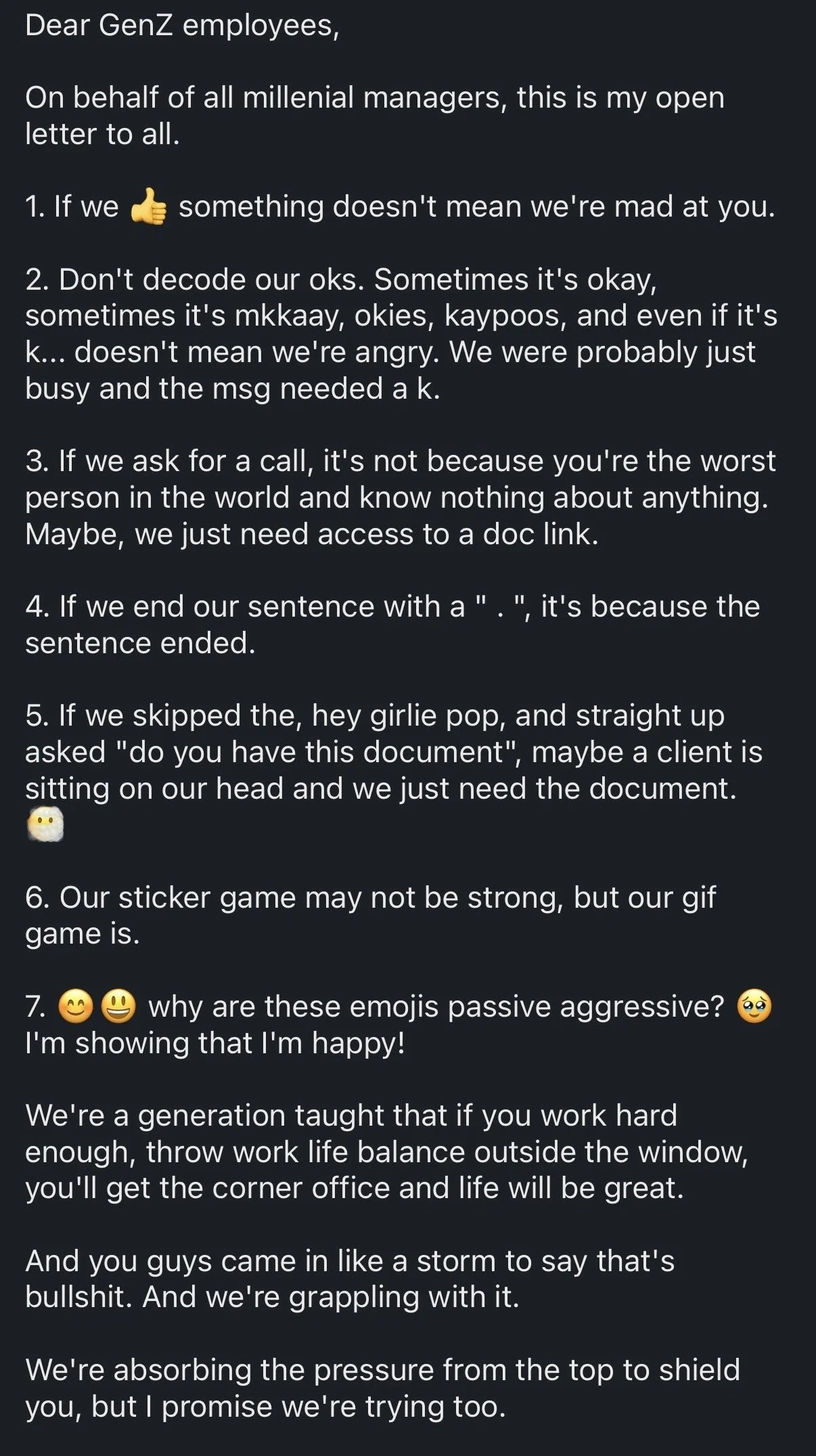
Reader, I was hooked by this rage bait.
Now, I’ve protected their identity, but that’s the last favor I’ll do for this human, because I don’t like assholes.
Seriously, though. This person sounds like an awful manager.
Because what I see is someone who knows their behavior triggers the nervous systems of their direct reports — someone who has been told “when you did X, I felt Y” — and then wrote a weird post about it on Linkedln, anyway.
And of course folks piled on Gen Z in the comments, because the algorithm loves a hot take almost as much as it loves a vapid post about a seat at the table.
So today I’m going to share some thoughts about Gen Z, communication, and why the first step in being a good manager is treating people with respect.
Yes, even in a Slack message.
The communication problem
In her brief-but-outstanding Neuroscience for Organizational Communication: A Guide for Communicators and Leaders Laura McHale introduces the concept of “occupational aprosodia” by writing:
“Humans have an astonishing ability to engage in meaningful dialogue. … [C]ommunication is not an individual act that exists in isolation, but rather a co-created system. It is a dynamic process between the person who is initiating the communication and the one who receives it.”
Prosody, she explains, “refers to the specific patterns of stress and intonation in spoken language.” She offers an example using the phrase, “That’s a nice haircut.”
“Whether this statement is a compliment, an insult, or something in between is down to prosody,” she writes. The difference is in the “intention conveyed through stress and intonation, and with facial expression and body language.”
Aprosodia (a word I can never remember how to pronounce) is a “neurological condition whereby a person is unable to properly convey or interpret emotional prosody.” McHale explains that people with aprosodia can’t tell the difference between sarcasm and sincerity.
McHale then dropped an insight that changed the way I think about internal communications — but really all text-based communication in our lives. She writes:
“I would argue that one of the key problems we have in communications is that we unintentionally induce an aprosidic-like syndrome through our organizational communication. … Organizational communication is aprosidic to the degree in which we take communication outside of its emotional context, and this occurs primarily through an overreliance on electronic communication, especially email.”
McHale argues there is a “substantial disconnect” between “the content of a message and the emotional context” in which it’s delivered.
When combined with an “over-reliance on electronic mediums,” it creates a “contextual communication deficit … so serious that it mimics an actual neurological disorder” (emphasis mine).
Maybe you can see where this is going.
Why I can’t stop thinking about Gen Z
I think about Gen Z a lot. In many ways, my curiosity about and respect for folks from this generation is the reason I founded my consultancy.
Not long after I began to address my own mental health (including understanding the role trauma plays in it), I started to think about everyone else who might be carrying anxiety, stress, grief, or other heavy stuff to work with them.
In particular, I thought about Gen Z, who has only ever known a world with active shooter drills. Who felt the disruption of the pandemic on a level I can appreciate but never understand.
I felt kinship in the ways I perceived them being intentionally misunderstood — like our Millennial Manager here — because as Thee Eldest Millennial, I, too, had once been intentionally misunderstood.
And when I came across McHale’s concept of occupational aprosodia, I immediately thought of Gen Z. The emojis. The punctuation.
I realized that Gen Z — the first to only ever learn and live with digital devices like laptops and smartphones — may, as a consequence, have adapted their communication style by necessity to accommodate occupational aprosodia.
In other words, in a world increasingly reliant upon digital technologies that strip emotions out of communication, they found ways to understand one another.
And I think there’s a lot we can learn from them.
What this means for managers
Of course folks have been introducing emotion into text for decades, like </sarcasm>, which became /sarcasm and is now just /s.
And I think it’s quite obvious why TikTok skyrocketed in popularity during the pandemic — video, as McHale notes, solves for prosody.
Yet business and organizational communication hasn’t quite caught up. The tools enable it — you can send GIFs and emojis through Slack, Teams, Google Chat, and the like — but do the norms allow for it? Not always.
And more to the point of this newsletter, even when folks do use emojis, there’s still room for misunderstanding. Take the thumbs-up. To a lot of Millennials it means “got it, thanks.” To a lot of Gen Z readers it comes across as cold, or even passive-aggressive.
At the end of my comment to this Millennial Manager, I wrote, “Idk, maybe try caring about other people. It’s not that hard and people will love you for it.”
In practice, caring looks pretty simple.
When I was leading a team in-house, one of the first conversations I’d have with folks who were joining the team was around communication. I’d ask them how they liked to receive feedback. Their overall preference for email vs messages. How we should structure our 1:1 time.
This, combined with greater conversations we had as a team around communications norms — things like how we treated after-hours pings; the choice for cameras to be off; the use of away messages and respect for DND mode — helped us understand how best to work together, and what to focus on when we needed clarification.
None of this involved more than a quick chat and a note on my desktop — which would also include things like their partner’s or kids’ names, pets’ names, and significant dates and anniversaries.
Things I avoided at all costs in messages:
Beginning a 1:1 ping by addressing someone by their first name (it can sound like a scolding)
Sending a “Hey.” with nothing else
Leaving a dangling, “Do you have a minute?” after that “Hey.”
Things I prioritized:
Stating why I was messaging someone
Stating what the urgency level was (as an external processor, anxious human, and vibrant Gemini with a creative, active brain I had to work hard at remembering this)
Using an AI tone-checker when in doubt
Those first two priorities became the first step of something I built into the Internal Calms® system earlier this year: the Settle Sequence, an order for information in any communication, designed to inform someone while minimizing the chance of distressing, distracting, or dysregulating them.
It begins with a short opening (typically one to three sentences, or in video, 10 to 15 seconds) that names the topic and the kind of communication it is, sets expectations for how long it will take and what’s required, and signals tone.
So instead of “Hey.” and “Do you have a minute?”:
“Hi! Nothing bad, just want to talk through how Tuesday’s client call went. Could we grab 15 tomorrow? Any time works.”
“Nothing bad” is a substitute for how your voice and face would tell someone in person.
That’s how the Settle Sequence begins: putting the prosody back.
Comms, this means you, too
To use McHale’s words, how do we imbue “emotional intent” in communication? I think the answer is in more than videos and live all hands, although these are both great channels and tactics to look at if they’re not part of your current strategy.
It’s also important to recognize the limitations of all your text-based channels and get creative in the ways you can convey emotional intent.
This can be through the words that you use, yes, but also more critically the context you provide for any particular communication. Even simply stating why you’re sending an email or a message can go a long way towards preventing dysregulating someone’s nervous system.
The Settle Sequence works the same way at scale. The difference is that a broadcast reaches hundreds of people at once, and anything you leave out, they fill in with guesses. That can be a lot of guesses.
In a company announcements channel:
“Schedule change, no action needed: this month’s all-hands is moving from Thursday to Friday, same time (10 a.m. PT). Thursday overlaps with the sales kickoff, and we want the sales team to be able to join. The agenda hasn’t changed, and your calendar invite has already been updated.”
The first few sentences of a hybrid work announcement:
“This email is about a change to our in-office schedule starting in January, and it’s a three-minute read. We know a change like this affects more than your calendar, so it’ll cover what’s changing, why, and where there’s still flexibility, including what to do if the new schedule won’t work for you. Your manager has the details and is ready to talk it through with you this week.”
In the company announcements channel post, sharing the reason for the move and the note that the agenda hasn’t changed answer what everyone would otherwise wonder: is something going on?
In the email, the line “We know a change like this affects more than your calendar” tells people someone recognizes what this costs them. Pointing them to their manager tells them they won’t have to figure it out alone.
Voice and face would do that work in person. In text, you have to write it in. It takes a few extra sentences each time, but it saves your readers from assuming the worst.
The rage-baity Millennial Manager thought Gen Z was too sensitive. I think these folks are paying closer attention to communication than the rest of us are, and we could stand to catch up.